The Egyptian Health Council Enhances Its Strategic Role at the National Cancer Institute Annual Conference
 عبدالرحيم فرعون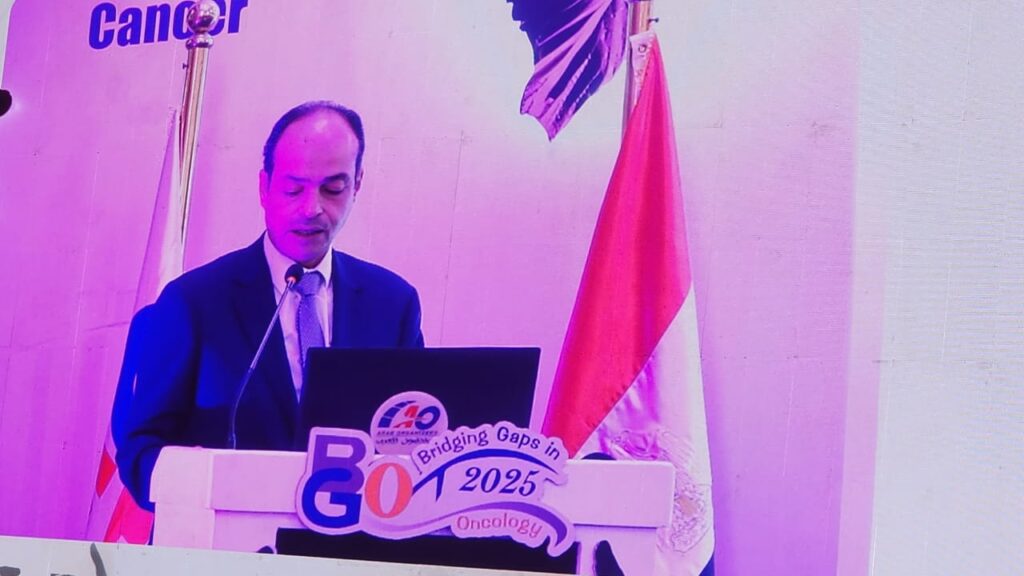
Abdelrehem abdelbary
On the second day of the National Cancer Institute’s annual conference at Cairo University, distinguished medical leaders gathered to discuss the advancement of cancer care and professional medical standards in Egypt. Among them was Prof. Dr. Mohamed Lotfy, CEO of the Egyptian Health Council, who delivered a keynote address emphasizing the council’s pivotal role in shaping medical practice, developing unified national training frameworks, and improving healthcare quality. His participation highlighted the collaborative vision shared between academic institutions and national health governance bodies to strengthen cancer care at every level.
In his address, Prof. Lotfy explained that the Egyptian Health Council is the central authority responsible for regulating and advancing medical training standards in Egypt. He stressed that continuous medical education is vital for improving patient outcomes, particularly in oncology, where treatment protocols and diagnostic technologies are rapidly evolving. He emphasized that modern cancer care requires physicians to adopt precision-based approaches, utilize molecular profiling tools, and integrate immunotherapy-based regimens—all of which demand structured and up-to-date academic and clinical training programs.
Prof. Lotfy noted that collaboration between the Egyptian Health Council and the National Cancer Institute represents a strategic model of integration between academic training and healthcare regulation. The institute provides a comprehensive scientific and clinical environment for developing advanced specialization pathways, while the council ensures that these pathways align with international frameworks for professional certification and competency assessment. This partnership supports national goals for improving early detection systems, patient survival rates, and clinical treatment consistency across all hospitals.
He further outlined the council’s efforts to launch unified postgraduate training programs in medical oncology, radiation oncology, clinical pharmacy, and nuclear medicine. These programs are being accredited based on global reference standards, ensuring that Egyptian specialists are equipped with competencies comparable to those in leading international cancer centers. Prof. Lotfy emphasized that these reforms are not only designed to enhance clinical decision-making but also to reduce disparities in care access and improve the distribution of qualified specialists nationwide.
Prof. Lotfy affirmed that Egypt has a deep reservoir of clinical experience and scientific talent in oncology. However, he noted that the challenge lies in strengthening coordination and establishing unified national strategic planning mechanisms. The Egyptian Health Council plays a critical role in integrating the efforts of universities, specialized hospitals, research institutes, and government agencies to build a consolidated national cancer care framework grounded in evidence-based practices and real-time health data systems.
He praised the National Cancer Institute for its scientific leadership, clinical services, and role in shaping the oncology workforce in Egypt. The institute’s multi-hospital system and continuous expansion—highlighted by the development of the 500500 Cancer Hospital—represent significant progress toward increasing treatment capacity and advancing Egypt’s position as a regional center of excellence in cancer research and care. He commended the institute’s faculty, hospital staff, and researchers for their dedication to both patient service and scientific innovation.
Prof. Lotfy concluded by emphasizing that the future of cancer care depends on sustained collaboration, a unified national medical education strategy, and strong investment in human capital. He reaffirmed the Egyptian Health Council’s commitment to elevating professional standards, improving healthcare safety, and preparing the next generation of cancer specialists to lead with competency, compassion, and scientific insight. He emphasized that collective national responsibility remains the cornerstone of progress in overcoming cancer challenges.
The participation of Prof. Dr. Mohamed Lotfy underscored the importance of aligned national strategies and collaborative institutional leadership in shaping the future of cancer care in Egypt. This conference served not only as a platform for scientific exchange but also as a decisive step toward strengthening a unified healthcare system capable of delivering high-quality, equitable cancer services to all citizens.